Your Cat Is Your Cousin
Why the Family Tree Is Far Bigger Than It Seems
That floof next to you is your cousin.
Your literal cousin.
A cat is roughly your 5 millionth cousin, millions of times removed, using a broad definition of cousin.
Each generation adds approximately one degree of cousinhood. Humans and cats share a common ancestor from about 90 million years ago, which puts the degree of cousinhood and the number of times removed in the millions.
What actually is a cousin?
Cousin means belonging to the same family, but not in the same direct parent-child line. A cousin is referred to as removed if they are separated by generations, for example cousins from your parent’s generation are once removed.
See the diagram below for a simple visual explanation of how cousin relationships are defined.
The overall evolutionary picture
In fact a similar statement can be made for all cellular life forms on Earth. Scientists believe that all cellular life on Earth is descended from a single common ancestor that lived 4 billion years ago. That means that all subsequent life (including bacteria, plants, and animals) is related.
The closeness of the relationship can be expressed in the same general way as it was for the cat, using the approximate number of generations in the past as the degree of cousinhood, and the difference between the number of generations of each branch as the times removed.
So using a table that mirrors the first cousin table shown earlier, the human-cat relationship is simply an extrapolation of the family tree we are all familiar with.
Putting some numbers on this, using estimates for several representative species, gives a clearer picture of the overall situation.
| Lifeform | Time since most recent common ancestor (million years) | Length of a generation (years) | Cousin degree from human (million) | Times removed from human (million) |
|---|---|---|---|---|
| E. coli (bacteria) | 4200 | 0.0027 | 210 | 1532790 |
| Algae (simple plant-like organism) | 1500 | 1 | 75 | 1425 |
| Banana | 1200 | 1 | 60 | 1140 |
| Cactus | 1200 | 1 | 60 | 1140 |
| Python | 325 | 15 | 16.3 | 5.4 |
| Cat | 92 | 4 | 4.6 | 18.4 |
| Dog | 87 | 4 | 4.4 | 17.4 |
| Punch (Japanese macaque) | 23 | 10 | 1.15 | 1.15 |
| Harambe (gorilla) | 9 | 20 | 0.45 | 0 |
| Chimpanzee | 6.5 | 20 | 0.325 | 0 |
The farther back the shared ancestor, the more distant the relationship
*How degree of cousinhood and times removed are calculated: Using the human-cat example, the most recent common ancestor is estimated at about 92 million years ago. Using a 20 year human generation, this corresponds to about 4.6 million generations (the degree of cousinhood). Using a shorter 4 year generation for cats gives about 23 million generations; the difference between these, about 18.4 million, is the number of times removed.
So admittedly, these lifeforms are very distant cousins but cousins nonetheless.
Bacteria are an extreme case
E. coli is the most extreme example shown because it separated much earlier from the human evolutionary branch than the other examples. Its short generational life span also dramatically increases the degrees removed. But even there we are cousins.
How do we know this is true?
How sure are scientists that all these lifeforms came from the same common ancestor? Based on current evidence, the scientific consensus is yes. As amazing as that sounds, it’s true. Much of the evidence comes from DNA (see: common descent in evolutionary biology).
DNA is passed down from generation to generation. It changes over time through mutation, but retains much of the same fundamental structure. All life uses the same basic genetic system down to the molecular level. Although many other coding schemes might have worked, including small differences that would not affect function, only one version is found across all life on Earth. It would be extremely unlikely for this exact system to have developed independently multiple times, which is why scientists conclude that DNA-based life today originated from a single ancestral source.
The LUCA
This earliest ancestor is called the last universal common ancestor or LUCA. LUCA is estimated to have lived about 4 billion years ago and would have been an extremely simple single celled organism.
Human populations are closer cousins
Contrary to the very distant relationship between species, most human populations are much more closely related. Estimates suggest that among all humans worldwide, we are probably no more than about 150th cousins.
The reason is that the number of ancestors grows rapidly with each generation. We all have 4 grandparents, 8 great grandparents. But just 10 generations back there are over 1,024 ancestors, and by 20 generations that number reaches about 1 million.
Within the same large region, we are even more closely related. For example, within the indigenous population of Europe, people may be no more than 30th or 40th cousins, corresponding to a common ancestor roughly 1,000 years ago.
In smaller or more isolated groups, the relationships are even closer, often in the range of 5th to 10th cousins as seen in populations such as Iceland, Polynesia, and the Amish in the United States.
Not everything that moves is a cousin
There are some biological forms that are not in our lineage, such as viruses. So you are not a blood relative of the COVID or influenza virus. That should provide some comfort.
Epilogue
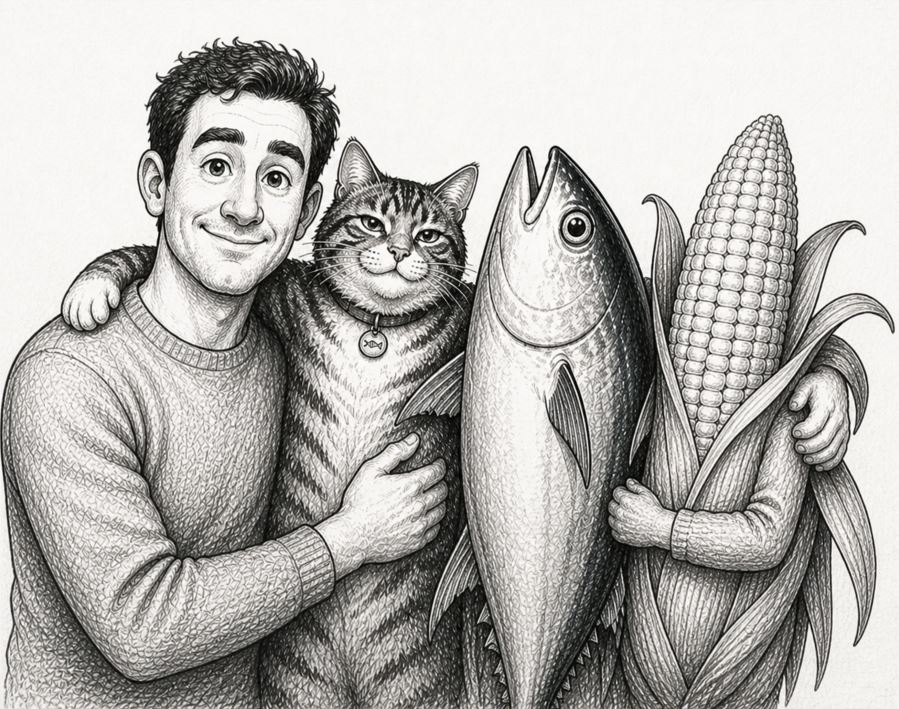
My cousin the cat is enthusiastically chowing down on its cousin, tuna fish packed into a can. Now excuse me while I do the same with my cousin, an ear of corn. At least the salt isn’t a member of the family.
Related ideas:
We Spend a Third of Our Lives Unconscious. Why?
The World's Largest R&D Lab