The Horns of Venus
Did the ancients know that Venus has a crescent shape?
The planet Venus as seen from Earth goes through phases like the moon. This fact became immediately obvious after the invention of the telescope. However, an unanswered question is whether this fact was known in antiquity?
The diameter of Venus, at its closest approach to the Earth, is just about at the lower theoretical limit of human visual acuity. At this point, when Venus is at its maximum apparent size, it appears as a bright unblinking star, often seen low in the sky near the horizon.
The view of Venus before the telescope
Venus was known to be different than a typical star, it was one of what the ancients called the seven wandering stars. We now know those to be the planets of the solar system visible from Earth by the unaided eye. Evidently for nearly all observers Venus was still simply a point of light. But there is an intriguing phrase that has appeared several times over history: "the horns of Venus". One interpretation of this is that at least some ancient observers may have been aware that Venus was more than a point of light.
This essay will discuss the evidence, and suggest ways that the theory can be tested today.
The horns of Venus
In mythology the planet Venus is often closely associated with the goddess Venus (also Aphrodite, and earlier, Ishtar). Depictions of the goddess sometimes include horns. Texts from the era refer to the horns of Venus, not to a crescent or arc. If the crescent were clearly visible, one might expect it to be described more directly. This suggests that when crescent shapes do appear in ancient art, they are most likely depictions of the Moon, not Venus.
The crescent, or any non-point shape of Venus, is not clearly mentioned in ancient texts, suggesting that if it was observed, it was likely rare, difficult to see, or not easily repeatable.
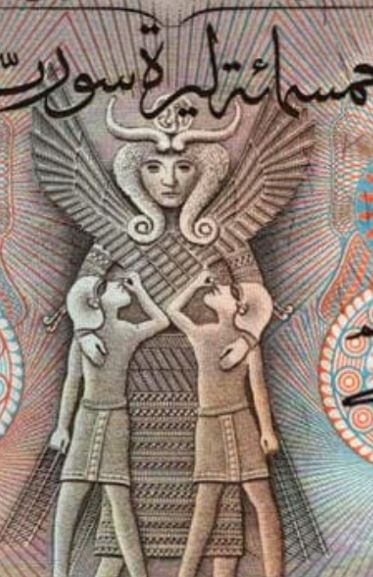
This was a topic of discussion over 100 years ago, in astronomical journals and has been discussed a few times since, but always with only anecdotal evidence offered.
Testing the idea
I propose some simple experiments we can do today to demonstrate clearly whether the non spherical shape of venus can be seen with the naked eye to answer at least part of the question.
The crescent shape of Venus is most extreme when its apparent size is largest.
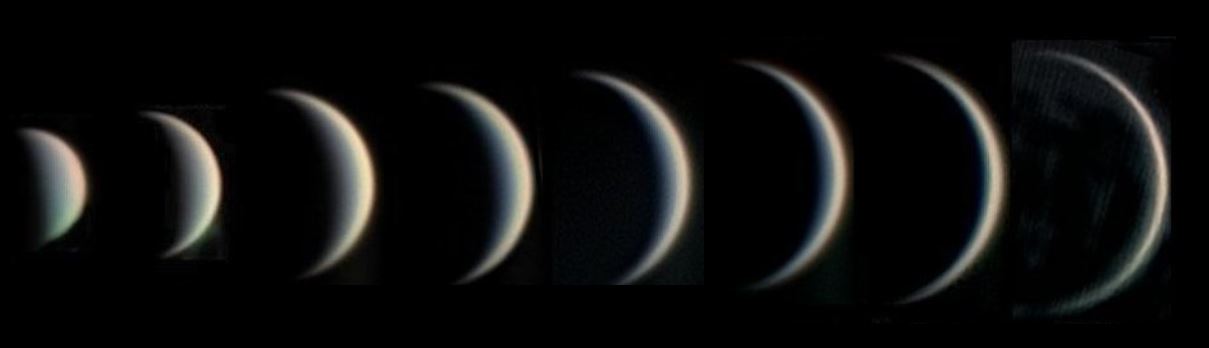
Observers could train their visual acuity on models, for example, an illuminated crescent shape about 2.75 mm in diameter viewed from about 30 feet away would match approximately what Venus looks like.
Simulating real conditions
A second step would be to obscure part of the crescent and observe what changes. Does it now look like a double point or even a horn-like appearance? The horizon does not need to be horizontal, since Venus could be setting against a cliff or hillside, of almost any angle.
Doing live tests on the actual planet Venus adds complexity. The brightness of Venus can obscure detail. It has been suggested just the right amount of haze might be required to reduce glare. Venus sets quickly, the entire disk disappears below the horizon in only about 5-10 seconds. The length of any interesting phenomena would be very fleeting. Perhaps just a flash and only visible in rather uncommon conditions.
A rare opportunity - the occultation of Venus
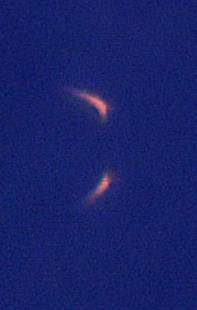
Another situation, perhaps the best real-world opportunity to detect the horns, is when the Moon occults Venus. In astronomy, an occultation is when one object passes in front of another and temporarily blocks it from view. This happens infrequently, and the specific orientation, where the unlit limb of the Moon occults the thick part of the crescent Venus first, is even more uncommon. At any location on Earth this might be visible about once a decade.
Ancient astronomers are not believed to have accurately predicted Venus-Moon occultations far in advance. As Venus and the Moon approached one another in the sky it would have been pretty obvious an occultation might occur and there would have been time for the astronomers to gather to observe the spectacle. These astronomers were trained on naked eye phenomena and would likely have been very interested in this.
The speed of an occultation is slower than the setting of Venus on Earth's horizon. The event takes perhaps two minutes giving observers a longer time to see any phenomenon.
A different question
This shifts the question. The issue becomes not whether people could see a crescent Venus, but whether they could detect any sign that Venus was not simply a point of light.
Here is a call to action: all you naked eye astronomy enthusiasts, and people interested in ancient deities, let's see what you can do.
References:
W.W. Campbell, Publications of the Astronomical Society of the Pacific 1916 Vol. 28, No 162, p. 85-86.
Joseph Offord, Deity of the Crescent Venus in Ancient Western Asia, The Journal of the Royal Asiatic Society of Great Britain and Ireland, April, 1915 pp 197-203
Goines, David Lance, Inferential Evidence for the Pre-Telescopic Sighting of the Crescent Venus , Oct. 1995
Related ideas:
You Learned About Your Five Senses, What About 6, 7, 8, and 9?
A Building the Size of a Soccer Field Could Hold Humanity's Accumulated Knowledge