You Learned About Your Five Senses. What About 6, 7, 8, and 9?
Balance, body awareness, and other senses you were never taught
We all learned in grade school about our five senses. Vision, hearing, touch, smell, taste.
Does this match what most people believe today about our senses? I did an unscientific poll among my family and most of them confirmed this is still the predominant view. We have five senses, period.
The traditional five human senses
But let’s deconstruct this list a little. First, touch. We lump several things together under touch when really they are different. What we commonly think of as touch is a sensitivity to low levels of pressure differences on our skin or movement of fine hairs. But in the “five senses list”, touch includes more than that; notably temperature and pain. Those are separate and should not all be lumped together. So now we are up to seven senses.
Taste is well known to consist of four categories, salty, sweet, sour, and bitter. More recently the experts have added more. Umami (meat-like), metallic, and others. But for this list I think it is fair to classify taste as one fundamental sense, with the different types of taste part of the overall sense itself, not separate senses.
The robot model
Consider a thought experiment. You are designing a robot; what sensory inputs are needed for it to function like a human? This approach quickly reveals which are the critical senses. Most of the seven above are obvious, but pain does not translate as cleanly. Think of it as how the body avoids or detects a serious problem. But there are more, as discussed below. Lacking these would lead to a nearly useless robot.
Balance
Without a sense of balance a robot would fall and be useless (see: sense of balance). We have all been exposed to the dizzy feeling after spinning and stopping, like during an amusement park ride. It can actually be fun in small doses. But most people don’t fully comprehend that losing your sense of balance for more than just a moment can impact your ability to function. It is needed to do almost anything requiring movement, walking, even sitting or eating. People who suffer from vertigo, a medical condition where the sense of balance is impaired, can experience constant dizziness, and in severe cases it can be disabling, making even simple movement difficult or unsafe. None of the other senses we have discussed will substitute for balance, so it is truly distinct.
Positional awareness
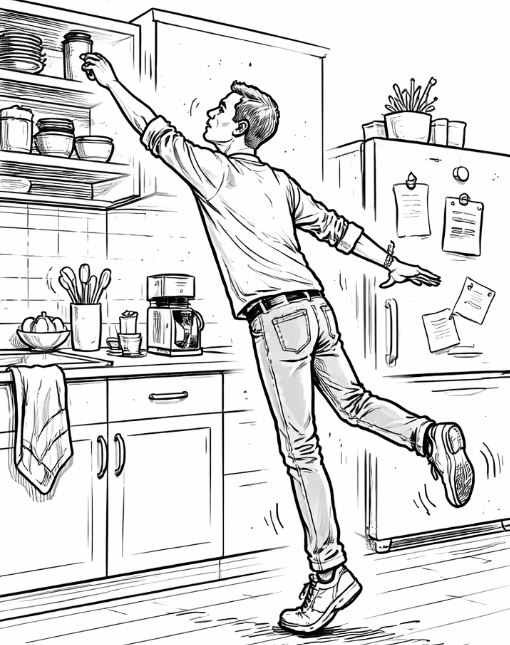
Another thing a robot needs is position sensors for every part of its body that moves. It is not practical to use vision to see where everything is at all times. That positional awareness is critical for the function of any self moving entity. We almost never think about how we are aware of exactly how our body is positioned. Our arms, legs, even tail (for a cat), and so on. You don’t need to look at the position of your limbs, or head, you just know. For example you can touch your nose with your eyes closed. Scientists call this ability proprioception and consider it a sense in its own right.
Other possible senses
Depending on how one defines a sense there may be more but they quickly become less clear as distinct senses. This includes things like the ability to sense your internal status, hunger, thirst, having to go to the bathroom. Sense of time is another one, pretty important but not strictly a sense.
So the list of nine is a reasonable stopping point, including the most clearly distinct senses without adding ones that don't stand well on their own. It is now demonstrably much improved over the traditional five.
Our nine basic senses:
- Vision
- Hearing
- Smell
- Taste
- Touch
- Temperature
- Pain
- Balance
- Proprioception
The wider animal kingdom
What about other animals? There are other senses that humans don’t even have the slightest ability or use for. Some animals can sense magnetic fields, for example birds use their ability to detect the Earth’s magnetic field to help with migration. Some fish can sense electric fields for example it is how sharks often locate their prey as they close in. Some animals have a sophisticated infrared detection system, not vision exactly but the ability to map out their environment by thermal imaging. And similarly echolocation used by bats and others is more than sophisticated hearing to the level that it could be considered another sense.
Putting it all together
There is nothing inherently wrong with the traditional explanation of five senses, but it works mainly as an easy introduction at a child’s level. A more complete view reveals that our sensory inputs are more complicated than that. Some of them work in the background, so smoothly you forget they are there. But the loss of any would be felt immediately. This fuller view of the key senses we experience helps you to better understand and appreciate how your body interacts with the world.
Related ideas:
The Awwww Factor: Why Things Feel Cute
We Really, Really Want to Be Right