The Math Is Right, but Something Doesn't Add Up
The problem with exponential growth assumptions
I am feeling generous this morning and instead of buying a coffee I am going to invest that money for my descendants. I will take that $5 and put it in the stock market. Into a fund they can't touch for 1000 years. Assuming a conservative real growth rate of 5%, basic investment math tells me it will be worth... about $7.3X10^21, or roughly 15 million times the current wealth of the entire world. No matter how optimistic you are, that is not going to happen.
This might seem impossible, but a 5% growth rate doubles about 7 times per century, or about every 14 years. Continuing that pace unabated leads to the numbers shown above.
A similar example uses the human population 2000 years ago, about 200 million. If the average number of children that survive to adulthood is 3, the human population today should be on the order of 10^21 people. That is about 62,000 people per square foot of land area on the earth.
Both these examples use very simple exponential growth models to predict into the future and both produce absurd results. The math is exactly right. The assumption that the growth rate can continue unchanged over that length of time is wrong.
More typical of many exponential growth situations is the S-shaped curve. For example bacteria in a Petri dish, or wild deer populations follow this pattern. Growth is exponential for a time, but as resources become limited, growth slows and eventually flattens.
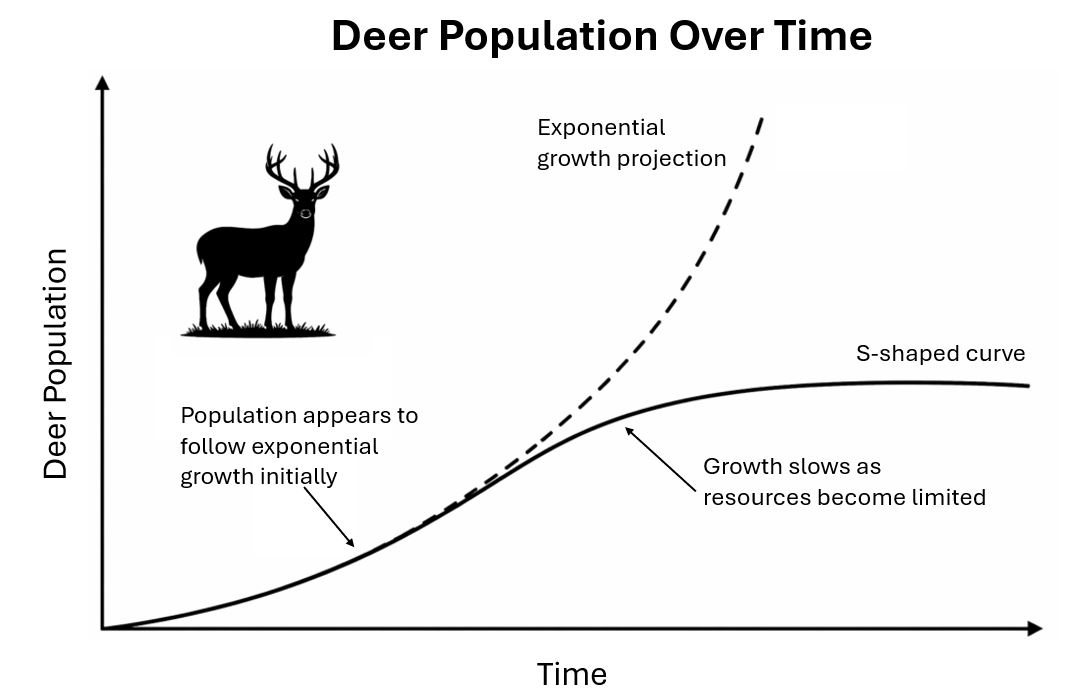
For something like human population, we know growth cannot continue at a constant rate indefinitely. But we don't know the exact mechanism which will cause it to slow down. Historically disease, war, and famine were usually the reasons. Recently we are seeing declining birthrates as societies become more affluent. Thankfully the latter seems more humane.
If extrapolating for 1000 cycles is too much, what is acceptable? There is no definite answer but the further we take the calculation the higher the risk of entering impossible territory.
In public policy and forecasting we see exponential growth estimates used frequently. Often the assumptions are not clearly stated and there is little attempt to consider whether the extrapolation makes sense. Even 50 year estimates can be risky.
The reverse situation can also be informative, exponential decay. Assume something will reduce by 1% a year. In 1000 years the level becomes vanishingly small. There are situations where we do hit zero. Extinction of a species is an example. But for many situations other factors will come into play which impact the reduction rate.
When is exponential growth or decay accurate in the long term? Exponential growth always runs into a limiting factor at some point. Exponential decay does exist in things like radioactive half-life. It is so accurate that age of ancient artifacts or even geological age of the Earth, can be estimated by the fraction of a known radioactive isotope remaining.
Exponential growth is a valuable mathematical tool. Just be careful of your assumptions.
Related ideas: