Does Luck Run in Streaks?
Yes but maybe not for the reason you think
Strictly speaking we are talking here about the outcomes that we call luck. And yes, defined that way luck does run in streaks.
But not because of some unseen force causing results to go in our favor (or the reverse, against us). The occurrence of streaks is the inevitable result of random chance.
What is a streak
A traditional explanation of a streak is flipping coins and getting a number of heads or tails in a row. Most of us know the previous flips do not affect what that next flip is going to be. So after getting 5 heads in a row there is still a 50% chance that the next flip will be heads. The laws of statistics show that we will occasionally get these long streaks. Mathematically, the chance of getting 5 heads in a row is, in fact, the same as any other exact combination of heads and tails.
The occurrence of streaks is not the issue. The problem is we can't predict when they will start or end and thus there is no way to take advantage of them.
The concept of streaks features prominently in gambling lore. A hot machine is expected to continue, or a cold machine has got to change soon. But in any truly random situation past performance does not affect future results. Any belief otherwise is essentially superstition.
There will be lucky streaks, unlucky streaks, back and forth results, and any other possible combination of results.
Some streaks are not random
The human mind excels at looking for patterns. It is a big part of what makes us special. And there is a reason for that. In nature many streaks are not random. They can reveal some underlying non-randomness that could be very important for survival. Much of humankind's early knowledge was based on this type of recognition. Birds circling overhead in the distance could be random, or could indicate something useful like a watering hole. We were rewarded to err on the side of recognizing a streak and investigating.
But games of chance are designed specifically to be random. So in that instance there is no reward for chasing a streak.
Identifying randomness
It can be difficult to distinguish between numbers that are truly random and numbers made up by a person trying to be random.
In a string of 100 random digits, on average there will be about 10 doubles and 1 triple. There is variation, but getting no doubles at all is extremely rare. Random lists of numbers are full of streaks and other seemingly non-random clusters. We look at them and think "that can't be random," yet it is. You can try it yourself here (opens in a new tab) https://numbergenerator.org/100randomnumbersbetween0and9).
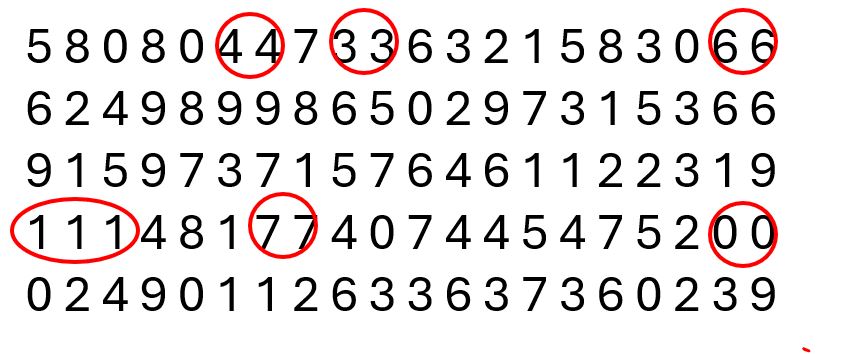
It is counterintuitive to the human mind to see a streak as possibly random. Ask anyone to give you a random three digit number. You are unlikely to get "111", even though on average 111 will come up one out of a thousand times.
The lack of streaks or other interesting clusters is actually evidence of not being random. People have been caught fabricating data because their fake data is missing streaks.
What do streaks tell us
So streaks are real, but there is no mysterious cause. They are simply a feature of randomness. In a truly random situation, they do not give you any guidance on your next move.
Recognition of patterns is one of our most important abilities. But be aware that streaks and patterns can and do occur due to random chance. Take this into account when determining how you respond.
Related ideas:
The Math Is Right, but Something Doesn't Add Up
We Really, Really Want to Be Right